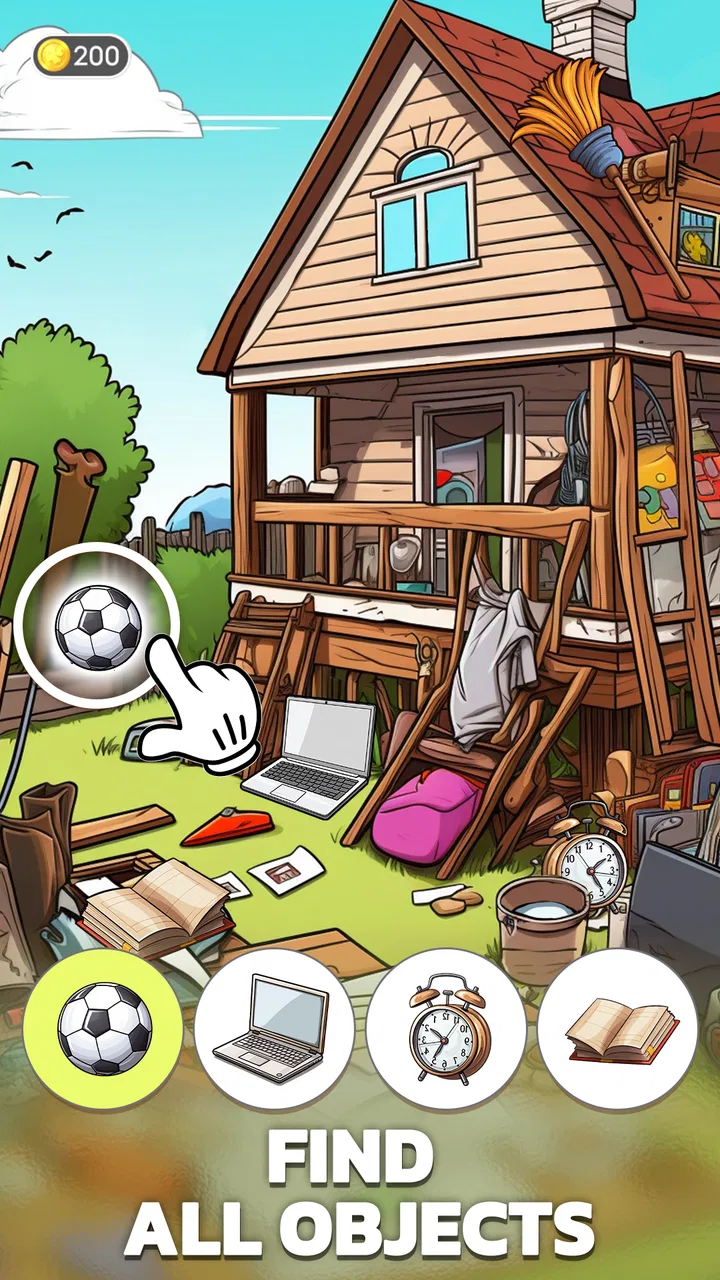
Hidden Folks: Scavenger Hunt
- 4.9
- Rating
- 10.00M
- Installs
- Free
- Price

 Analysis by App-foxy
I approached Hidden Folks: Scavenger Hunt expecting a relaxed board game built around looking carefully, but I quickly found that its real appeal is the way it turns ordinary searching into a small investigation. The basic idea is simple: you explore a busy scene, look for a requested person or object, and solve a chain of visual puzzles. What makes it enjoyable is that the answer is rarely sitting in the most obvious place. The scene asks me to slow down, notice patterns, and test details instead of tapping randomly.
This is a free game from LifePulse Puzzle Game Studio, aimed at Everyone, and it fits naturally into short breaks as well as longer sessions. Its store presence is strong, with a 4.9 average from around 194 thousand ratings and over 10 million installs. Those figures make sense to me after playing: the concept is immediately understandable, but the search challenges have enough texture to keep the experience from feeling like a disposable time-filler.
Finding your way through the search-and-find puzzles
The first thing I noticed is that the game rewards observation more than speed. A crowded illustration can make me believe I have already checked an area, yet a tiny change in color, shape, or position can reveal the target. That creates a useful rhythm: scan broadly, narrow the possibilities, then inspect the scene again with a more deliberate question in mind.
You May Also Like

 Blood Strike: 2.5 Anniversary
Blood Strike’s Loadouts Turn Every Drop Into a Tactical Gamble
A close look at Blood Strike’s custom loadouts: how fast access to signature weapons reshapes its battle royale rhythm, rewards preparation, and narrows the gap between fights.

 Pandora - Music & Podcasts
Pandora’s Music Is Easy to Start, but Harder to Recover
Pandora’s strength is its low-effort path from a seed to a station. Its weak spot is how much confidence it asks you to place in connection, setup, and quiet recovery.

 8 Ball Pool
 Is Built on Rivalries, Rematches, and Routine
A close look at the rivalries, rematches, shared routines, and unanswered safety questions that turn a quick pool match into a persistent mobile community.

 Samsung Music
’s Quiet Strength Is Playing What You Already Own
Its reach comes less from spectacle than from dependable access to a personal library. That simplicity is both the app’s strongest retention engine and its ceiling.

 AccuWeather: Weather Radar
AccuWeather Review: A Quick, Clear Forecast for Everyday Decisions
For everyday plans, the best forecast is the one you can understand quickly. AccuWeather makes rain timing, radar, and local conditions easy to act on, with a few trade-offs.

 Hill Climb Racing
Why Hill Climb Racing Still Turns Crashes Into One More Run
A tiny car, a bumpy hill and one more upgrade: Hill Climb Racing keeps resurfacing because its simple chaos makes every near-miss feel personal.
More From Our News Desk
View All News


The best way to play is not to drag my attention randomly across the screen. I divide the picture into sections and work from one edge toward the other. When I find something interesting, I remember its location rather than immediately assuming it is the requested answer. This simple habit reduces repeated searching and makes the larger scenes feel manageable.
Some players will enjoy the quiet concentration, while others may find the pace too slow. This is not the right choice if you want quick reflex challenges, competitive scoring, or a constant stream of action. The satisfaction comes from recognition. I get a small reward from realizing that the clue was visible all along, especially when the scene initially looked like visual noise.
The board-game classification is useful because it describes the kind of attention the game demands. It feels closer to a visual tabletop puzzle than to an arcade title. I can pause mentally between discoveries, discuss a suspicious detail with someone nearby, or hand the device to another person and compare what each of us noticed.
Where players commonly get stuck
The most common difficulty is not necessarily a hard puzzle. It is losing a clear search method. After looking at the same area several times, I can start seeing what I expect to see rather than what is actually there. When that happens, I stop scanning the whole picture and change the question: am I looking for a whole figure, a small object, a particular color, or something partly hidden by surrounding details?
Another source of friction is assuming that the target must be near the center of attention. In a scavenger-hunt scene, prominent objects naturally attract the eye, but the requested item may blend into a less dramatic part of the composition. I have had better results by checking edges, corners, clusters of similar shapes, and places where several visual elements overlap.
It also helps to separate discovery from confirmation. If I see something that might be the answer, I tap it carefully and then continue from the same area if the result is not what I expected. Jumping immediately to the opposite side of the scene makes it easy to create a loop in which I keep revisiting familiar places without learning anything from them.
For children, the game can become a shared observation exercise rather than a solitary test. An adult can ask guiding questions without giving away the answer: “What color should we look for?” or “Which parts of the picture have we not checked?” That approach keeps the child involved and avoids turning the session into a frustrating hunt for a single pixel.
Setup checks before blaming the puzzle
Because this is a visual game, the first setup check is the screen itself. I play with a comfortable brightness level and clean the display if small details begin to look muddy. A dim screen, glare, or a cracked protector can make a scene feel unfair when the real problem is simply that fine visual differences are harder to distinguish.
The game supports devices running Android 6.0 or later, and the current version is 1.2.6. If installation or launching becomes troublesome, I would first check that the device meets that basic operating-system requirement and has enough free space for a normal app installation. I would also close other demanding apps before assuming the puzzle itself is responsible for slow response.
A practical setup habit is to rotate the device only if the game behaves well with that change. Repeatedly switching orientation while searching can interrupt concentration and make it harder to remember which portions of a scene I have already examined. I prefer to settle into one comfortable position before starting a difficult search.
Touch accuracy matters too. If taps are landing beside the intended area, I avoid playing while the device is charging in an awkward position, remove anything that makes the screen difficult to reach, and try a clean restart. These are ordinary checks, but they matter more in a game where a small tap can determine whether a suspected object is correctly identified.
The free price makes it easy to try without committing money, which is one of the game’s strongest practical advantages. I can install it for a short break, test whether the visual-search format suits me, and decide from actual play rather than from the description alone. The Everyone rating also makes it approachable for family use, although younger players may still need help with especially dense scenes.
Recovering a session when progress feels confused
When I lose track of what I have already checked, I do not restart immediately. First, I return to a systematic route around the scene. I mentally mark four or five broad zones and inspect each one only once before moving on. This restores a sense of progress without throwing away the work I have already done.
A useful recovery technique is to describe the missing item in neutral terms. Instead of thinking, “I cannot find that little character,” I ask myself whether the clue points to a person, an object, an unusual color, or a position within the environment. Removing the emotional label of “impossible” often makes the visual relationship easier to notice.
I also take short breaks when my attention becomes repetitive. After staring at a busy image for too long, every shape begins to merge with the next. A minute away from the screen can be more effective than another ten minutes of frantic tapping. This is especially relevant for the game’s intended relaxed style: patience is not a side benefit here; it is part of the solving method.
If the game appears to stop responding, I treat that separately from being unable to solve a puzzle. I check whether other apps respond normally, close and reopen the game, and make sure the device is not overloaded. If only one scene seems difficult, the issue is probably my search process rather than a technical fault. If the entire app becomes unresponsive, ordinary device troubleshooting is more sensible than repeatedly tapping the same location.
I would avoid clearing app data as a first reaction, because that can affect local progress in games. A restart is a safer initial step. Likewise, reinstalling should be a last resort rather than a routine fix, particularly if I care about preserving my current place. These are cautious habits, but they prevent a small moment of frustration from becoming a larger loss of progress.
When the game is not the cause of the problem
Not every disappointing session reflects a design flaw. A small phone screen can make detailed scenes less comfortable than they would be on a larger display. If I am playing in a moving vehicle, under harsh sunlight, or while tired, I am much more likely to miss visual clues and blame the puzzle for my own reduced attention.
Accessibility and comfort are also personal. Someone with difficulty distinguishing close colors may find certain searches more demanding, while another player may enjoy exactly that extra layer of observation. I would test the game in a calm environment before deciding whether its visual style works for me. If the core task remains uncomfortable even with good lighting and a larger screen, a word puzzle or audio-focused game may be a better alternative.
Compared with a traditional hidden-object game, this title is more convenient for spontaneous play because it is already on a phone and does not require a table, pieces, or another player. Compared with a standard board game, it offers less physical interaction and less conversation by default. Its strength is focused visual exploration, not social strategy or competition.
It also differs from match-three and fast puzzle games in an important way: there is no need for me to optimize a chain of moves under pressure. That makes it more suitable for winding down, sharing with a child, or filling a quiet waiting period. On the other hand, players who want visible progression through increasingly complex mechanics may prefer a traditional puzzle app with levels, timers, or score-based goals.
The game works particularly well in an everyday scenario such as a short afternoon break. I can open it while waiting for an appointment, solve part of a search, stop when my attention is needed elsewhere, and return later with a fresh view. It is also a good choice for two people sharing one device: one person can describe where to look while the other controls the screen, then they can swap roles.
Who should try it, and who should skip it
I would recommend it to players who like hidden-object books, visual riddles, “I Spy” activities, and calm games that reward patience. It is especially appealing if you enjoy studying a scene for small relationships rather than simply matching identical shapes. Families may find it useful as a cooperative observation activity, provided everyone is comfortable sharing the device and allowing the search to unfold at its own pace.
I would be more cautious about recommending it to someone who needs a game with a strong competitive layer, rapid feedback, or a clear strategic system. If you want to build an engine, defeat opponents, or improve through fast repetition, the usual board-game adaptations and action puzzles will probably offer more energy. This game asks for a different kind of commitment: attention without urgency.
There is also a trade-off between its accessibility and its potential repetition. The basic interaction is easy to understand almost immediately, which is excellent for casual players. But because the central activity remains searching through scenes, anyone who dislikes visual scanning may feel that the variety is limited even when the individual puzzles are thoughtfully arranged.
LifePulse Puzzle Game Studio has positioned the game as a straightforward scavenger-hunt experience rather than an intimidating puzzle laboratory. That simplicity is a genuine benefit for first-time players. I never need a long tutorial to understand what I am supposed to do. The challenge comes from applying the idea carefully, not from learning a complicated control system.
My practical verdict after using it
My overall impression is that Hidden Folks: Scavenger Hunt succeeds because it respects the pleasure of looking closely. It is free, rated for Everyone, and easy to approach, yet it can still make me pause over a scene and rethink what I have already seen. The strongest sessions are calm and collaborative, especially when I use a structured search instead of tapping wherever my eye happens to land.
I would install it for relaxed visual puzzles, family-friendly shared play, and short sessions that do not demand sound, speed, or a complicated rules explanation. I would skip it if my priority is competition, action, or deep board-game strategy. The game is not trying to replace those experiences, and judging it by those standards would miss its main strength.
My best advice is to prepare the screen, choose a comfortable setting, scan in zones, and take a break when your eyes start repeating the same search. If a technical problem appears, restart cautiously and separate device behavior from puzzle difficulty before taking more drastic steps. With that approach, the game becomes a pleasant little investigation rather than a frustrating hunt.
For me, that makes it a worthwhile recommendation: not because every search is effortless, but because the moments of discovery feel earned. The real appeal is the quiet satisfaction of noticing what everyone else might overlook.
FAQs for Hidden Folks: Scavenger Hunt
01What is Hidden Folks: Scavenger Hunt?
Hidden Folks: Scavenger Hunt is an interactive puzzle game where players search for hidden objects in intricately drawn landscapes. Each scene is filled with tiny characters and objects, all beautifully animated. The game offers a charming, hand-drawn style and encourages players to explore and interact with the environment to find the listed items.
02How does the gameplay of Hidden Folks work?
The gameplay involves exploring various scenes to find specific hidden objects. Players tap on different parts of the scene to interact with items and characters. Each level provides clues to help locate the hidden objects. As you progress, the scenes become more complex, requiring keen observation and patience.
03Is Hidden Folks suitable for children?
Yes, Hidden Folks is suitable for children and offers a family-friendly experience. Its simple mechanics, lack of in-app purchases, and non-violent content make it an excellent choice for kids. The hand-drawn art style is appealing to all ages, and the game helps improve observation skills and attention to detail.
04Are there any in-app purchases in Hidden Folks?
No, Hidden Folks does not include any in-app purchases. Once you purchase the game, you have access to all content without additional costs. This makes it a great option for those who prefer a complete, uninterrupted gaming experience without the need for further spending.
05What platforms is Hidden Folks available on?
Hidden Folks is available on multiple platforms, including Android and iOS. This ensures that players can enjoy the game on both smartphones and tablets. Additionally, it is available on PC and Mac, giving users the flexibility to choose their preferred device for an optimal gaming experience.
Pros
- Charming hand-drawn graphics.
- Interactive environments with surprises.
- No ads to disrupt gameplay.
- Multiple languages supported.
- Relaxing and stress-free experience.
Cons
- Limited replay value once completed.
- Some levels can be quite challenging.
- No online multiplayer mode.
- Requires significant storage space.
- Occasional small interface glitches.

Hidden Folks: Scavenger Hunt
Gallery